
The Media Buyer’s Guide to EV Charging Advertising
Meta description: Buying EV charging advertising? Here’s the checklist serious media buyers use — impression methodology, dwell time, dayparts, geo targeting, and a 90-day test structure.
EV charging advertising is now on the media plan for one reason: it is the only place a driver stands still for twenty minutes with nothing else to look at. But the channel is young, and the inventory isn’t uniform. Two networks can both quote “digital screens at charging stations nationwide” and deliver completely different products.
This guide is the checklist to run before you sign an insertion order.
The Inventory Isn’t Uniform — Ask What You’re Actually Buying
Not every charger has a screen, and not every screen is worth buying. Level 2 chargers and DC fast chargers create very different sessions: a fast charger may hold a driver for 18 to 30 minutes, while a Level 2 unit at a grocery store or theater can hold them far longer. Ask which mix you’re buying and in what proportion.
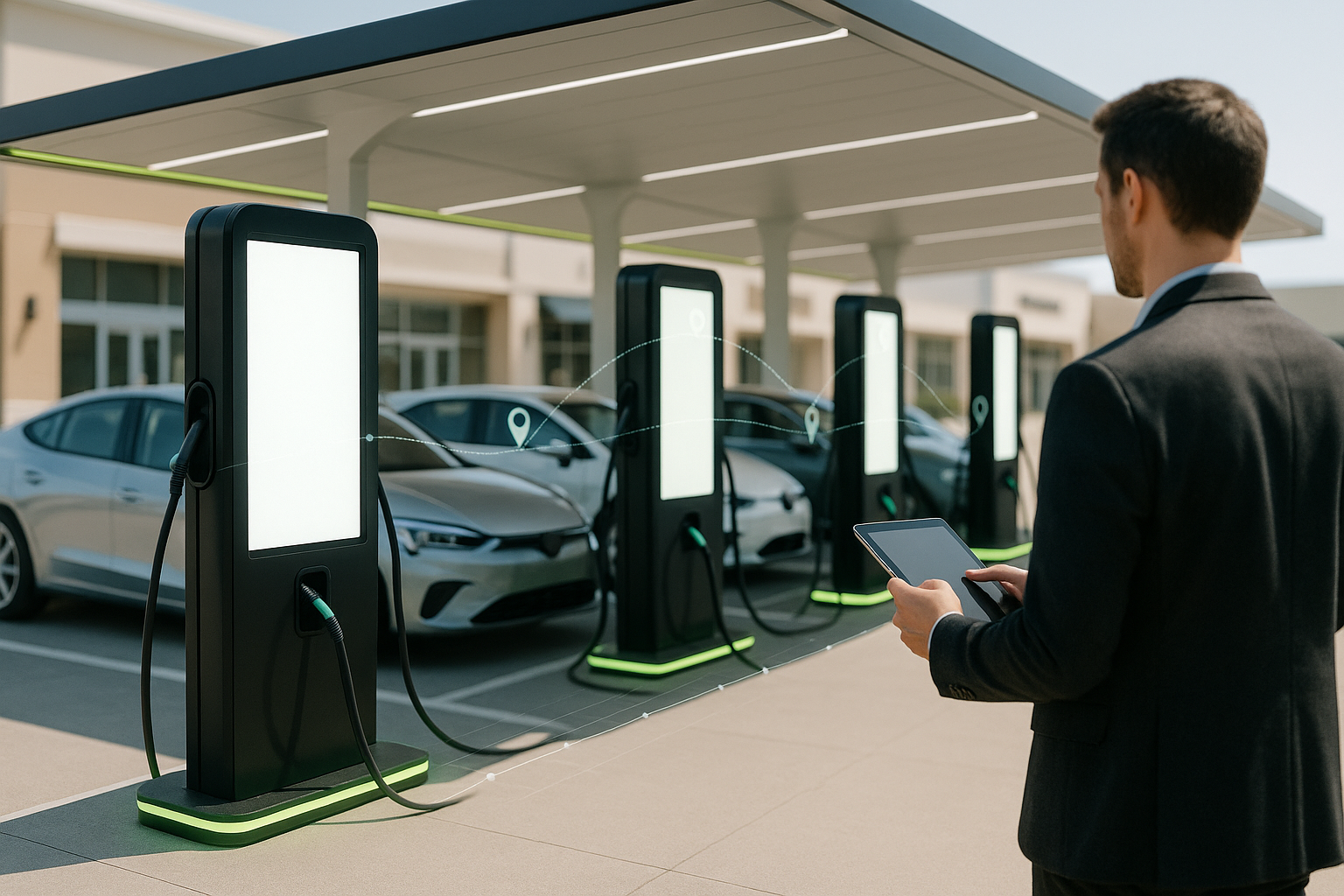
Then get specific about the hardware: screen size, orientation, resolution, brightness in nits, and whether audio is available. A 55-inch vertical display at eye level under a canopy is a different product than a small panel mounted to the side of a pedestal.
Finally, ask where those units physically sit. Grocery, retail plaza, movie theater, mixed-use garage — location type drives who sees your message, at what hour, and in what frame of mind.
Impressions Need a Definition, Not a Range
“Monthly impressions” means nothing until you know how it was counted. Ask directly: is this screen-level session counts, verified plays, or a modeled figure built from traffic estimates?
For a charging network, the defensible base unit is the charging session. One vehicle plugged in is one person who cannot leave. From there, standard out-of-home practice applies — verified play counts and audience estimates should be traceable, not proprietary.
Request the methodology in writing and ask for sample reporting from a comparable flight. A network that can show you the last campaign’s delivery is a network that can be held to yours.
“The first question we ask any network is simple: show me how a number was produced. If they can’t, the number goes in the plan at face value, and that’s how you end up defending a channel you can’t explain.”
— Media planning lead, national agency
Buy Dayparts, Not Averages
Charging has a rhythm. Commuters plug in early. Shoppers plug in midday and on weekends. Evening sessions skew toward longer dwell and fewer distractions. A network that sells you a flat monthly average is selling you the average of three audiences you could have bought separately.
Ask for session volume by hour and day of week across the units you’re considering. Then match your creative rotation to it: a lunchtime grocery audience and a 9pm garage audience should not see the same 15-second spot in the same order.
- Weekday morning: commuter and errand traffic, shorter dwell, high frequency
- Weekday midday: retail and grocery dwell, strongest for considered purchases
- Weekend: family and leisure sessions, longest average dwell times
- Evening: extended sessions, lower competitive noise on screen
Geo Selection: Match Stations to Sales Territory
The advantage of a station network over a highway billboard is granularity. You can buy the trade areas where your product is actually sold. Give the network your store list, dealer footprint, or ZIP-level sales data, and ask them to propose stations that fall inside those boundaries rather than a DMA-wide blanket.
Two things to confirm while you’re there: whether the network can exclude stations near competitor locations, and whether it charges separately for location-level reporting. Both should be answered in the rate card conversation, not after the flight starts.
“We stopped buying metro-wide. When we mapped stations to the trade areas where our product actually moves, the same budget started showing up in the sales numbers.”
— Retail brand media manager
What Belongs in the Insertion Order
Put the following on paper before launch. Every line here is a question the network should be able to answer without a follow-up call.
- Unit mix: number of stations, split by charger type and location category
- Screen specs: size, orientation, resolution, brightness
- Impression methodology: how counted, by whom, reported how often
- Daypart schedule: hours of operation and creative rotation rules
- Geo list: named stations or ZIP-level selection criteria
- Creative specs: dimensions, formats, file requirements, lead time for changes
- Reporting cadence: weekly, mid-flight, and final delivery reports
- Make-good terms: what happens if a screen goes dark
Run a 90-Day Test, Not a 12-Month Commitment
New channels get killed by oversized bets. Start with a defined footprint — a single market or a matched set of stores — for 90 days, and hold a comparable control group with no charging-network exposure.
Days 1–30: establish baseline delivery. Confirm the impression numbers you’re getting match the methodology you were promised.
Days 31–60: layer your measurement. Add a brand lift study, a matched-market sales read, or a promo code unique to the channel so you can see response directly.
Days 61–90: compare test against control and calculate cost per incremental outcome, not cost per thousand. That number is what earns the channel a line in next year’s plan.
Where This Channel Wins — And Where It Doesn’t
Be honest with your client about fit. Charging-station advertising performs when you need sustained attention, a message with more than three seconds of substance, or reach into an affluent, early-adopting, tech-forward audience in retail environments.
It is not the right buy for reach-maximizing campaigns, frequency at national scale, or anything requiring immediate action in under five seconds. Say that out loud in the plan review. The channels you talk a client out of are the ones that make the ones you recommend credible.
Your Partner for the Next Flight
EV Across America operates a nationwide network of 6,000+ digital charging stations in high-traffic consumer districts — grocery, retail, theater, and mixed-use locations — with 24/7 ad rotation and reporting you can take into a client meeting.
You get a single point of contact, creative specs and lead times up front, station-level detail on request, and a team that will tell you when a location isn’t worth your budget.
Build your next flight with confidence. Request a rate card and a market-by-market station list, and we’ll map the footprint to your sales territory before you commit a dollar.
- Media hotline: [contact info needed]
- Email: [contact info needed]
- Location: United States
Let’s Talk
Which part of this checklist is hardest to get from the networks you’ve evaluated — the impression methodology, the daypart data, or the station list? Tell us where the gap is, and we’ll show you exactly how we report against it.
Have a campaign already running somewhere else that underdelivered? Send it over. We’ll tell you honestly whether a charging footprint would have changed the outcome.