
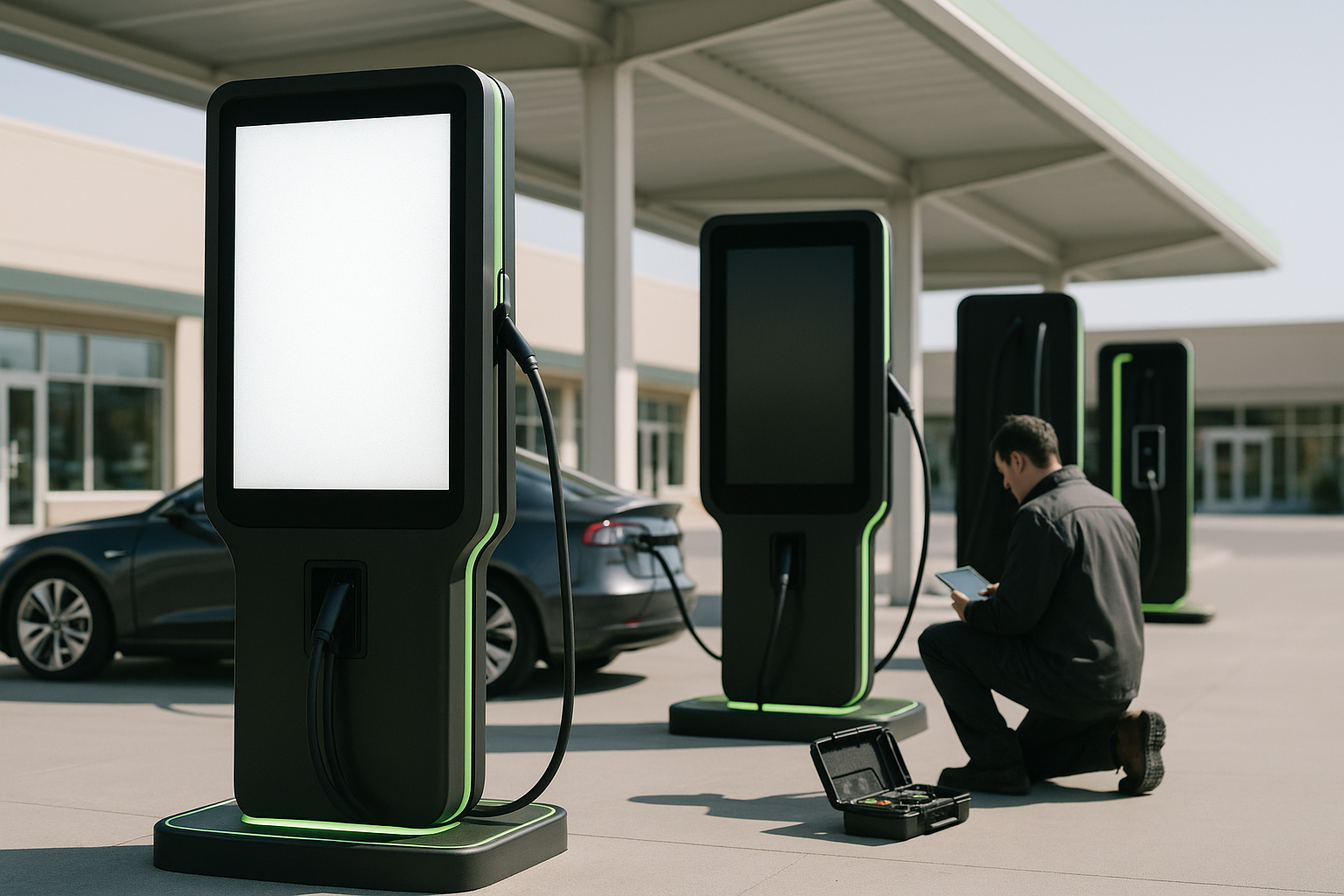
The Uptime Question: What Happens to Your Ad When the Charger Goes Dark
Meta description: A dark charger screen is a paid impression that never happened. Here’s how media buyers should vet charging-network uptime before they sign.
Two charging networks can quote you the same station count, the same dwell time, and the same monthly rate. Then one of them delivers the impressions and the other doesn’t.
The difference is rarely in the media plan. It’s in the parking lot, on a Tuesday afternoon, when a screen that was sold to you as live has been dark for six days and nobody has noticed.
The Screen Is a Machine in a Parking Lot
An EV charging advertising display is not a poster. It is an outdoor electronic device with a power supply, a network connection, a control board, and a glass surface that takes weather, road grit, and the occasional shopping cart.
It will fail. Every screen in every network fails eventually. The only question worth asking as a buyer is what happens during the hours it isn’t working — and who is accountable for them.
When a charger goes dark, two things break at once. The driver loses a charge. You lose an impression you already paid for. Neither event is visible in a monthly report that simply states impressions delivered.
Your ad rotation continues running on the server. There is just no glass on the other end of it.
Why the National Footprint Number Tells You So Little
A network can say “6,000 digital stations” and mean 6,000 screens that could theoretically carry an ad. Whether those units are powered, connected, and rendering your creative tonight is a different number entirely — and it’s the one that determines your actual reach.
That gap is where budgets quietly go missing.
A station can be offline for a power fault, a connectivity outage, a damaged display, a software fault, or simply a site that has been decommissioned while the location list still carries it. From the buyer’s side, all five look identical: an impression that never reached a person.
“The number you want from a network isn’t how many screens it has. It’s how quickly it knows one has stopped working — and how fast a technician is dispatched when it does.”
Dan Kost, Founder, EV Across America
What to Ask Before You Sign
You are not asking for a guarantee that nothing will ever break. That’s not a reasonable standard for outdoor hardware, and any network that promises it is telling you something about its reporting rather than its maintenance.
You are asking for visibility and accountability. Six questions get you there.
- How are screens monitored? Look for automated, continuous station-level monitoring — not a manual quarterly audit or a driver complaint queue.
- How fast is a failure detected? The gap between an outage starting and the network knowing about it is your exposure window.
- What is the technician response time? Detection without dispatch is just documentation.
- Can you see station-level delivery data? You want reporting granular enough to show which screens ran your creative, not a single blended national total.
- What happens to my spend during an outage? Ask directly whether paused or dark screens are credited, and get the answer in the insertion order.
- Who coordinates with the property owner? Site access, power, and permits all affect how long a screen stays down. Ask who owns that conversation.
Uptime Is a Reporting Feature, Not Just a Maintenance One
Here is the part media buyers tend to miss. Uptime doesn’t live in the operations department. It lives in the reporting you receive.
A network that can tell you precisely which screens were live during your flight can also tell you what your real delivered impressions were. A network that can’t tell you that is asking you to take its impression count on faith — and to accept that a dark screen and a working screen land on the same line of the invoice.
Ask for the station-level view. If the data exists, the delivery story is verifiable. If it doesn’t exist, that’s your answer.
Why This Works in Your Favor
Charging screens carry a structural advantage that most out-of-home inventory can’t match: the audience is stationary for twenty minutes, in a known shopping district, and the screen sits at eye level beside a car that is deliberately parked.
That’s a genuinely strong media position. It’s also a position that only holds when the hardware is live.
A driver who pulls up to a dark charger and leaves doesn’t become a wasted impression — they become a bad experience with your brand sitting on the screen next to the broken machine. Uptime protects both sides of the transaction.
The Question That Separates Two Networks
Bring one question into your next network conversation: How do you know, right now, which of your screens are working?
The answer will tell you more about what you’re buying than the station count, the deck, or the rate card. Ask it before the contract, not after the first quarterly review.
Frequently Asked Questions
What counts as a charging screen outage? Any period when the digital display is not rendering scheduled creative to a visible audience — including power loss, connectivity loss, hardware damage, or a software fault. A charger that still charges but shows nothing is still an outage for advertising purposes.
Should I expect a credit for dark screens? Ask for it in writing. Not every network offers outage credits, and terms vary. The important thing is that the policy is stated up front and that station-level data exists to verify it.
Does a lower station count mean a worse network? No. A smaller network with continuous monitoring and fast dispatch can deliver more verified impressions than a larger footprint with no station-level visibility. Reach you can prove beats reach you can’t.
How does uptime affect my creative? It doesn’t change what you should build — brief for a standing, captive audience either way. It changes how much of the audience actually sees it.
Can I audit this myself? At minimum, request station-level delivery data and ask what monitoring system produced it. A network that can show you the dashboard is a network that can show you the outages.
Put Your Budget Where the Screens Are Actually On
EV Across America operates a nationwide network of more than 6,000 digital charging stations in high-traffic consumer districts — grocery stores, theaters, retail plazas, and other locations where drivers park and stay a while. Every screen runs 24/7 ad rotation, and the audience is captive for the full charging session.
If uptime is on your evaluation list, let’s talk about how the network is monitored and what station-level reporting looks like for your flight.
- Explore the network: evacrossamerica.com
- Request a media kit: reach the team through the site to discuss station availability in your target markets
- Ask for the station-level view: request delivered-impression reporting by site before you commit budget
Have a question about charger-screen advertising that we haven’t answered here? Send it over — the questions media buyers actually ask are the ones we build the next guide around.
EV Across America is a program created by Dan Kost, a USA Entertainment Ventures, LLC company.