
The Handoff: What Happens on the Charger Screen Between the Ad and the Charge
Meta description: Your charger-screen ad shares a column with a charging status readout. Here’s why the handoff between the two decides whether your twenty-minute dwell earns goodwill or friction.
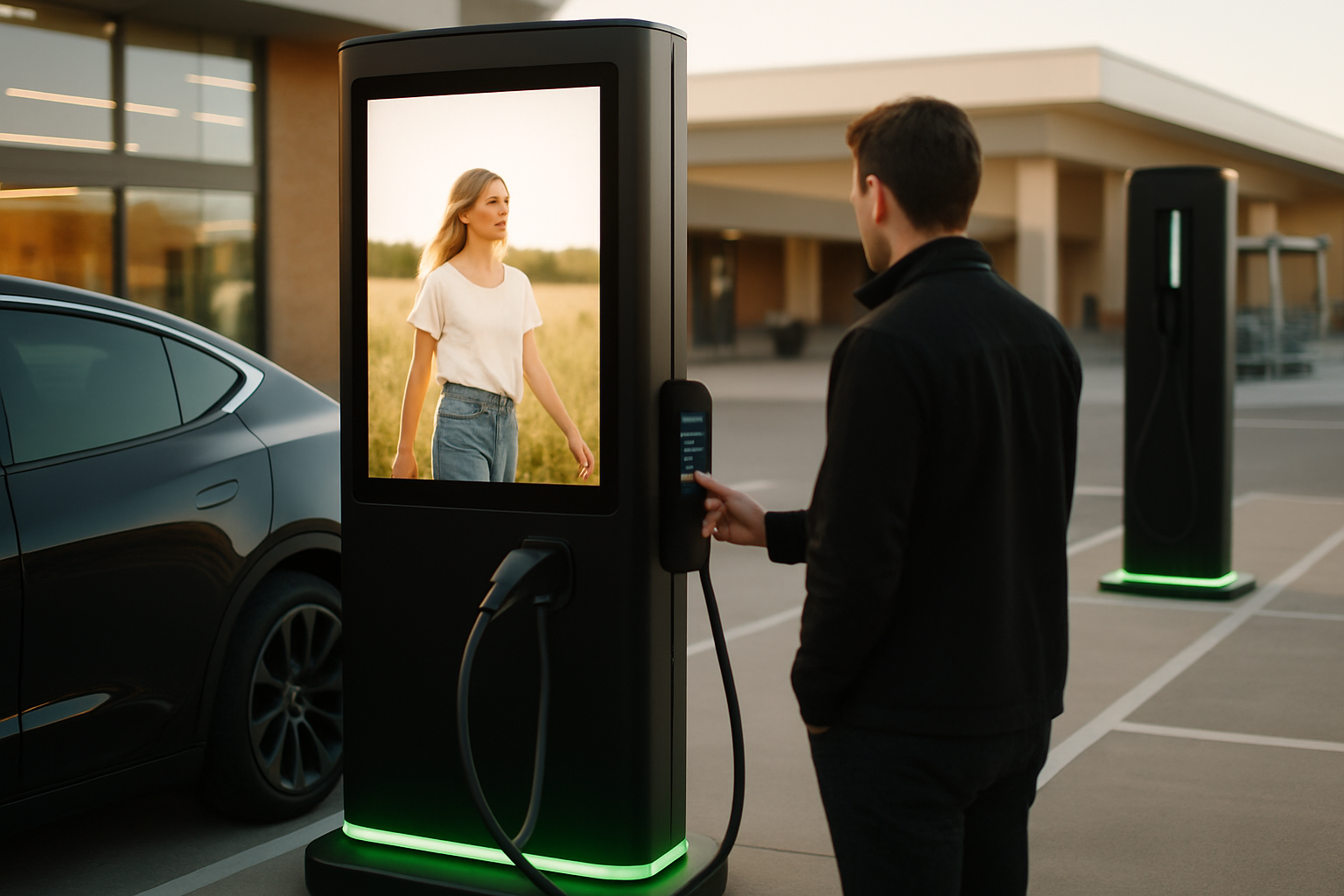
A charging column does two jobs at once. It delivers a charge, and it plays your ad. Those jobs sit inches apart on the same piece of hardware, and the person standing in front of it can only look at one of them at a time.
That’s the handoff. It’s the moment the driver checks how much longer they’re stuck, then looks up at whatever you bought. Most brands brief the second half of that sentence and never think about the first. The ones who understand both are the ones whose charger-screen buys earn a second flight.
Your ad is a guest on someone else’s hardware
The screen you’re buying is mounted on equipment the driver already has a relationship with. They drove here for the charge. They are not here for you.
That single fact should reset how you think about the placement. You aren’t renting a billboard on a highway. You’re renting twenty minutes of attention from someone who is also checking a status readout, glancing at their phone, and deciding whether they have time to run into the store.
“The brands that win on a charger screen treat the session as a shared space, not a slot they own. You’re standing next to the customer, not in front of them.” — Media planning principle we brief every host site and advertiser relationship around
Read the column the way the driver reads it. Status first — how full, how long. Then everything else. If your creative assumes it’s the only thing on that column, it’s fighting the charger for the customer’s eyes and losing.
Frame the charge as usefulness, not interruption
The strongest-performing charger-screen creative answers a question the driver already has, or gives them something to do with the wait.
- Solve the errand. Store hours, the pharmacy counter, which entrance is closest to the deli. Information the driver can act on before they unplug.
- Name the wait. “Next time, download the app and skip the line.” Anchoring the message to the session the driver is in makes the ad feel timed to them, not dropped on them.
- Reward the stop. A code for the aisle they’re about to walk into beats a code for a product they have to drive somewhere else to find.
- Keep it legible from the driver’s seat. A driver reading through a windshield across the lot gets less resolution than one standing at the cable. Build for the worst seat, not the best one.
Each of these does the same job: it makes the twenty minutes feel shorter, which is the only currency that matters on a charger screen.
Respect the readout
The charging status panel is the reason the driver is looking at the column. Anything that obscures, competes with, or slows that readout is a cost you’re imposing on a customer who is mid-transaction.
This isn’t a hypothetical. It’s an operational requirement you should be able to state on the call:
- Your ad runs in rotation with a dedicated status panel, and the status panel never loses priority.
- Your ad never covers the charge timer, the power rate, or the session cost.
- Your ad never mimics a system message — no fake progress bars, no counterfeit “session complete” language, no simulated error states.
That last point matters more than it sounds. A message that looks like the charger talking is a message the driver may act on. That’s not clever creative. That’s a problem for the host site, the network, and your brand.
What to brief when you place the order
Hand the creative team a one-page brief that names the conditions, not just the concept.
- The screen and the readout share a column. Note the layout so the creative doesn’t assume a full-bleed canvas.
- The audience is standing still for roughly the length of a charge. Build a message that reads once and rewards a second read, not a three-second cut.
- The session comes first. Any element that could be mistaken for charging information is out.
- The setting is specific. Grocery lot, theater lot, retail plaza. Write for the errand that’s already happening.
- The dwell has a mood. Twenty minutes is long enough to become bored and long enough to become annoyed. Aim for the first, avoid the second.
Send that brief with the media order instead of after it. Creative built before the placement is understood tends to fight it.
The goodwill math
Charger-screen inventory is reserved per location. The people standing in those lots are your customers, and they’ll stand there again next week.
A brand that makes a charging stop easier gets remembered at the moment of a small inconvenience. A brand that makes it worse gets remembered too — just not the way the plan projected. There’s no impression metric that captures the difference, which is exactly why the handoff has to be a creative brief item and not a note for later.
Build for the person, not the panel. The screen is the introduction, not the whole relationship.
Make your charger-screen creative work in the space it actually lives
EV Across America operates a network of over 6,000 digital charging stations in high-traffic consumer shopping districts, and we brief every placement against the conditions in the lot, not just the site list. If your team is building charger-screen creative, we’ll share the screen layout, the session context, and what’s working on the columns before you shoot.
- Email: [contact info needed]
- Phone: [contact info needed]
- Where we are: [contact info needed]
Frequently asked questions
Does my ad replace the charging status display? No. Your creative rotates alongside a dedicated status panel. Charging information keeps priority — the driver always gets the readout first.
How long is a charger-screen ad actually seen? A charging session is a single extended stop, not a stream of short glances. Build for a standing viewer who may look twice, not for a fraction-of-a-second impression.
Can my ad use progress bars or session-style graphics? Don’t. Anything that could be read as charger system messaging creates confusion for the driver and risk for the host site. Keep your brand clearly separate from the hardware’s own communication.
What should the first frame of my creative do? Identify the brand and the offer immediately. The driver decides in the first second whether this is worth their attention, and you only get one shot at that decision.
What are you seeing in the lot?
If you’ve run creative on a charger screen, tell us what the session did to your numbers — we’d rather learn from your results than our projections. Reach out and we’ll compare notes. And if your team is starting a charger-screen plan for 2027, send us the brief and we’ll tell you straight whether the placement fits what you’re trying to build.