
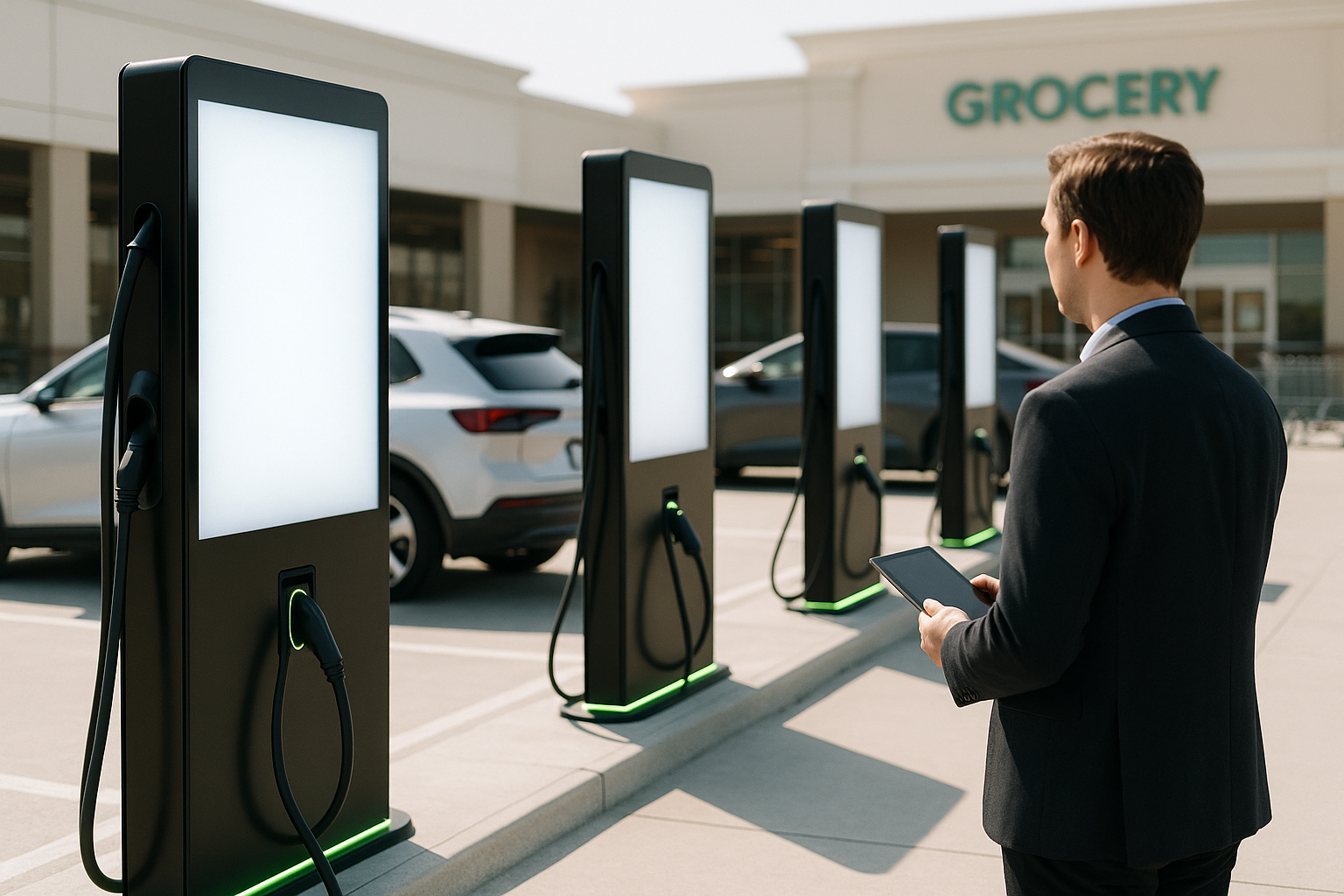
Your Parking Lot Is Already a Media Channel. Most Property Owners Don’t Bill It That Way.
Meta description: Charging stations on your property are a media asset, not just an amenity. Here’s how host sites turn parking into advertising revenue — and what to check first.
There is a charging column in your parking lot right now. It takes up two spaces, draws power, and cost you nothing to install. You think of it as a tenant amenity. It is also a digital billboard with an audience that stands in front of it for half an hour.
Most property owners take the amenity and leave the revenue sitting on the pavement.
That is the gap worth closing this lease cycle.
The Amenity Math Stops Too Early
The standard host-site conversation goes like this: a charging network offers to install and maintain equipment at no capital cost to you. You give up a few parking spaces. In exchange, your tenants get a service, and your property looks forward-looking.
Then the conversation ends.
What it skips is that the same column carrying the charger also carries a screen. That screen is networked, remotely managed, and sold to advertisers. On a functioning network, it generates revenue every hour the lot is occupied — and the lot is occupied every hour your tenants are open.
“The charging station is the only asset on a retail property that both serves customers and earns media revenue. Owners who treat it as one or the other leave money in the lot.”
— EV Across America network overview
Two income streams sit on one piece of concrete. Most properties only count one.
What a Host Site Actually Controls
Before you sign anything, understand which levers belong to you. A well-structured host agreement leaves the property owner with real influence over the asset standing on their land.
- Placement. Which lot, which row, and how much visibility the screen gets from the main drive aisle. A screen nobody passes earns nothing.
- Screen orientation. Facing the pedestrian path or the vehicle approach — each reaches a different reader at a different moment.
- Content standards. The right to review advertiser categories you don’t want adjacent to your tenants. A family grocery and a billboard for a competitor down the street are not the same placement.
- Tenant priority windows. Space reserved for your own promotions, your anchor tenants, and center-wide events.
- Term and revenue structure. Whether compensation arrives as a flat host fee, a share of advertising revenue, or a hybrid.
If a prospective partner won’t discuss these before installation, that is your answer.
Why the Audience Is Worth More Than the Space
Advertisers pay for attention, and a parking lot during a charging session produces something scarce: a person standing beside their vehicle with time on their hands and no second screen competing for it.
They are already in a retail mindset. They chose your property. They are between trips — arriving, or about to leave with a purchase in the car.
That is a fundamentally different reader than someone scrolling past an ad at a traffic light. The session length does the work. A driver charging for a full session is present, stationary, and repeatedly exposed to the same screen.
Captive attention. Retail intent. Repeat exposure. Those three together are what a media buyer is actually buying.
How the Revenue Reaches the Property
Mechanics vary by network, but the structure is consistent enough to plan around.
The network sells advertising space across its station footprint. Revenue funds equipment, installation, maintenance, connectivity, and content management. What remains is shared with host sites under the terms of the agreement.
For the property owner, the practical result is a parking space that produces income without staff, without capital outlay, and without a construction project. The electricity and the maintenance sit on the network’s side of the ledger.
No install cost. No service calls. No staff time.
Your team keeps doing what it does. The lot keeps earning.
Running Your Own Message on Your Own Screens
This is the part most host sites underuse.
A charging screen on your property is a channel you can program. Promote the anchor tenant’s weekend sale. Announce holiday hours. Point drivers toward the store entrance, the pharmacy counter, or the pickup lane. Fill empty storefronts with leasing information aimed at people already standing in the center.
The audience is on-site, mid-visit, and physically close to the destination you’re promoting. That is the highest-intent placement your marketing budget can buy, and on your own property it is already built.
The Checklist Before You Sign
Bring these questions to every conversation.
- How many screens are in the network, and where do they sit by market?
- Who handles installation, maintenance, connectivity, and outages?
- How is host compensation calculated, and on what reporting?
- What content review rights do I keep?
- How much screen time is reserved for my tenants?
- What does performance reporting look like, and how often?
- What are the exit terms if the equipment underperforms?
Get answers in writing. A partner confident in their footprint will hand them over without hesitation.
Your Lot, Your Call
The charging columns going into retail lots nationwide are not temporary. Driver adoption keeps moving in one direction, and properties without charging will eventually be the ones explaining why.
The choice is not whether your lot participates. It is whether you participate as a host with revenue terms, screen time, and content control — or as a landlord who handed over two spaces and kept the maintenance.
One agreement separates those outcomes.
If you already host charging equipment and have never asked what the screen earns, that is the first conversation to have this quarter. If you are evaluating charging for the first time, build the revenue terms into the original discussion — not the second amendment.
Let’s Talk About Your Property
EV Across America operates a network of more than 6,000 digital charging stations in high-traffic consumer districts — grocery stores, theaters, retail centers, and other destinations where drivers already spend time.
If you own or manage a property and want to know what your parking lot can earn, we’ll walk you through the numbers.
Contact us:
- Email: [contact info needed]
- Phone: [contact info needed]
- Location: [contact info needed]
- Web: evacrossamerica.com
Have you evaluated a charging host agreement on your property? Tell us what the terms looked like — and what you wish you’d asked first. Drop your experience in the comments below.
FAQ
What is a charging station host site? A host site is a property that allows an EV charging network to install and operate charging equipment in its parking area. The host typically provides the spaces and access to power; the network supplies, installs, maintains, and manages the equipment.
Can a property owner earn revenue from charging station screens? Yes — where the network sells advertising on the charger displays, host sites can receive compensation under the terms of their agreement, often as a host fee, a revenue share, or a combination of both. The specific structure is set in the host contract.
Do I have to pay for the charging equipment? On the standard host model, no. The network funds installation and ongoing maintenance, and the property owner contributes the parking spaces and site access.
Can I advertise my own tenants on the charging screens? On most networks, host sites can reserve screen time for their own promotions and tenant messaging. Confirm the amount of reserved time and how it’s scheduled before you sign.
What should I ask a charging network before signing? Ask about network size and market density, who covers maintenance and outages, how host compensation is calculated and reported, what content review rights you keep, reserved tenant screen time, and your exit terms.
How long does a charging session last? Session length varies by vehicle and charger output, but charging stops commonly run well past the few seconds a driver spends passing a roadside billboard — which is what makes the display a usable advertising surface.